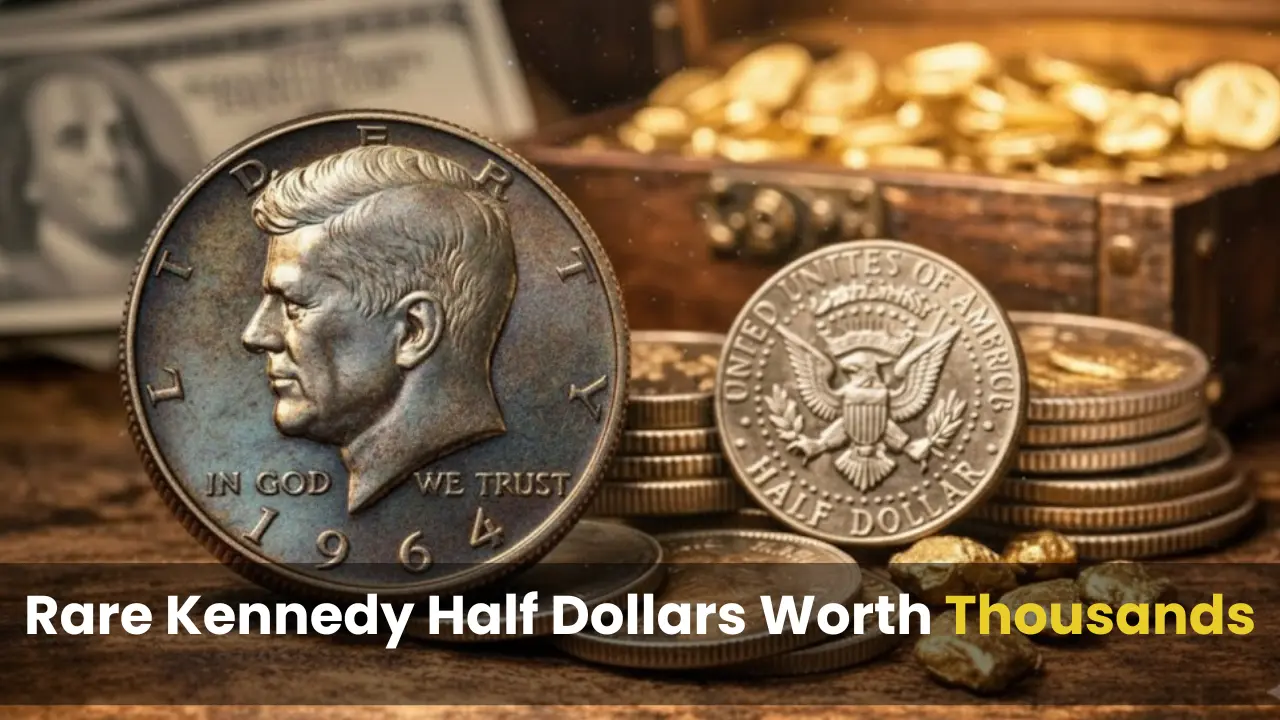
Kennedy Half Dollar The Kennedy Half Dollar was first released in 1964 to honor President John F. Kennedy after his tragic assassination. Produced by the United States Mint, the coin quickly became more than everyday change. People lined up at banks to collect it as a keepsake, and many were saved rather than spent. Because of this emotional and historical connection, the series has remained one of the most collected modern American coins. While millions were minted, only a small percentage are considered rare and valuable today.
Complete Information Table
| Year | Mint Mark | Composition | Special Feature | Estimated Value Range* |
|---|---|---|---|---|
| 1964 | None / D | 90% Silver | First Year Issue | $20 – $10,000+ |
| 1964 SMS | None | 90% Silver | Special Strike | $100,000+ |
| 1964 Proof | S | 90% Silver | Accented Hair Variety | $500 – $20,000 |
| 1965–1970 | Various | 40% Silver | Transitional Silver | $5 – $5,000 |
| 1970 | D | 40% Silver | Mint Set Only | $50 – $5,000 |
| 1998 | S | 90% Silver | Matte Finish | $200 – $5,000 |
| Various | Various | Mixed | Major Mint Errors | $100 – $50,000+ |
Silver Content and Why It Increases Value
One of the most important factors in determining value is metal composition. The 1964 issue was struck in 90% silver, giving it strong intrinsic melt value. From 1965 to 1970, the silver content dropped to 40%, and after 1971 regular circulation coins were made from copper-nickel. Even common 1964 coins are usually worth more than fifty cents due to silver content alone. However, the real premium comes when a coin is rare and preserved in exceptional condition.
Mint Marks and Their Meaning
Mint marks tell collectors where a coin was made. Kennedy Half Dollars were struck mainly in Philadelphia, Denver, and San Francisco. Coins without a mint mark (before 1980) were made in Philadelphia. A “D” represents Denver, and an “S” indicates San Francisco. The mint mark appears below Kennedy’s neck on most issues. While mint marks help identify origin, they only add major value when combined with low mintage, rare varieties, or special finishes.
The Famous 1964 Special Strike
Among all Kennedy Half Dollars, the 1964 Special Strike—often called the 1964 SMS—is one of the rarest. These coins are different from regular circulation and proof coins. They show unusually sharp details and a smooth satin-like surface. Only a handful are known to exist, making them highly desirable. When certified in top condition, they have sold for six-figure amounts at major auctions.
The 1964 Accented Hair Proof
Another important variety from 1964 is the “Accented Hair” proof coin. This version shows more detailed hair above Kennedy’s ear. It was later modified, which makes the original design scarcer. High-grade examples of this proof variety are sought after by collectors and can sell for thousands of dollars depending on condition.
The Key 1970-D Issue
The 1970-D Kennedy Half Dollar was never released for general circulation. Instead, it was included only in special mint sets, making it a key date in the series. Because fewer were distributed to the public, collectors consider it an important piece. Coins in mint state condition with strong luster and minimal marks often command higher premiums.
The 1998-S Matte Finish Silver Coin
In 1998, a special matte finish silver Kennedy Half Dollar was issued as part of a commemorative set honoring Robert F. Kennedy. With a limited mintage of fewer than 65,000 pieces, it has become a modern collectible favorite. Perfectly graded examples can sell for several thousand dollars and remain in steady demand among serious collectors.
Valuable Mint Errors to Watch For
Mint errors can dramatically increase a coin’s value. Doubled die obverse coins show visible doubling in letters or numbers. Off-center strikes display part of the design missing due to misalignment during striking. Wrong planchet errors occur when a coin is struck on a blank meant for another denomination. Clipped planchets show curved or straight missing sections from the coin’s edge. Strong, clearly visible errors in high grade condition are especially valuable.
Why Professional Grading Matters
Condition is everything in coin collecting. Coins are graded on a scale from 1 to 70. Even a small difference at higher grades can mean thousands of dollars in price difference. Two of the most respected grading companies are Professional Coin Grading Service and Numismatic Guaranty Company. Certified coins often sell for higher prices because buyers trust their authenticity and grade.
How to Check Your Coins at Home
Start by examining the date and mint mark. Focus on 1964, 1970-D, and special proof or silver issues. Use magnification to inspect for doubling or unusual features. Silver coins weigh slightly more than copper-nickel versions, so weighing can help confirm composition. If you believe you have a rare piece, consult a professional dealer or submit it for grading. Never clean a coin, as cleaning can significantly reduce its value.
Final Thoughts
The Kennedy Half Dollar remains one of the most beloved modern U.S. coin series. While most examples are common, a few rare dates, varieties, and errors have achieved remarkable auction prices. By understanding silver content, mint marks, grading, and unique features, collectors can identify coins that may be worth far more than their face value. Sometimes, an ordinary-looking half dollar can turn out to be an extraordinary treasure.